Order books full, bank account empty? Why liquidity at SMEs has to be a top priority

30.07.2026

Revenue is like food, profit like drink, and liquidity like oxygen: this is the analogy used by Swiss finance manager Luca Baroni to describe why a lack of cash spells immediate trouble for SMEs and the routines, strategies and mindsets companies can use to avoid dangerous liquidity bottlenecks.

Luca Baroni, experienced CFO, board member, interim manager and guest lecturer, presents a chart at a training course showing how to calculate the liquidity required for operations.
Sharing his valuable knowledge: Luca Baroni, CFO with over 25 years of C-level experience, board member, interim manager and guest lecturer.

At a glance

  • The best advice: liquidity must be the number one priority for every SME.
  • The most important lesson: profit is not money in the bank. There is often a dangerous time lag between invoicing and payment.
  • The first strategy: good customer and supplier contracts, digitization of payment processes – both incoming and outgoing.
  • The best routine: rolling liquidity planning and an honest weekly look at the numbers.
  • The most important safeguard: reserves, scenarios and a banking relationship in place before things get tough.

Digitize all your invoices with PostFinance – with just one interface.

How SME liquidity bottlenecks come about.

The order books are full. The margins are right. The annual figures are looking good. Everything should by rights be running smoothly. And then it’s the end of the month. Salaries are due. Supplier invoices need to be paid. VAT is due. At the same time, the biggest customer invoice has been issued, but the money won’t be coming in for another three weeks. On paper, the company is doing well. The bank account tells a different story. It’s precisely here that one of the most common financial problems for SMEs begins: the company is making money, but doesn’t have it available when it matters most.

Profit is not liquidity: the most common financial mistake made by SMEs

Luca Baroni puts the problem in a nutshell: “The most common and most dangerous mistake in the financial management of an SME is confusing profit with liquidity. A company can be profitable and still find itself in a liquidity crisis – which sounds paradoxical, but is often the reality.” This mistake is often not recognized until it’s almost too late: when suppliers are demanding payment and there’s nothing in the account. Baroni describes the importance of liquidity with an analogy from a lecture that stuck with him: “Revenue is like food, profit is like drink and liquidity is like oxygen.” In other words: without liquidity, the situation immediately becomes critical.

Profitable ≠ liquid

  • In accounting terms, profit is when revenues exceed expenses.
  • Liquidity, on the other hand, means that the money is actually available in your account.
  • There are often weeks between the two – which is precisely where the shortfall is.

About Luca Baroni

Luca Baroni is a proven finance expert who, as CFO of major Swiss companies such as Swissgrid, BLS and Alpiq, has seen what it comes down to in challenging situations. As a course instructor, he shares his knowledge at basic and advanced training institutes, for example at the KMU Leaders Campus.

Why liquidity is particularly important for Swiss SMEs

Liquidity is the lifeblood of every company. “For SMEs that do not have direct access to capital markets, generally have only small cash buffers at their disposal, and tend to be more reliant on bank loans, liquidity is a particularly sensitive issue,” explains the finance manager. In Switzerland, this is further complicated by the fact that many SMEs are export-oriented and invoice their services in euros or US dollars. If the Swiss franc appreciates against these currencies, margins often fall in the short term – while salaries, rent and many operating costs still have to be paid in francs. This can put liquidity under additional pressure, and foreign exchange risks are added to the liquidity issue. Luca Baroni: “The performance of the franc can significantly change margins – and the profit and liquidity situation – within a just a few months.”

On top of that, many SMEs do not have a specialized treasury team to monitor cash flows on a daily basis. CFOs – or often the business owners themselves – wear several hats at once. “Matters handled by a team and a structured reporting system at major corporations must be made up for at SMEs through disciplined personal responsibility and pragmatic tools,” he emphasises. 

Liquidity planning at SMEs: the three most common mistakes

Luca Baroni sees three main reasons why SMEs tend to stumble when it comes to liquidity planning.

  • There is a lack of systematic, regular planning. Liquidity is managed reactively rather than proactively.
  • Receivables estimates are too optimistic. Customers pay later than expected, which tears holes in planning.
  • There is no liquidity reserve in place for unexpected events and stress situations. The pandemic demonstrated how quickly external shocks can tip the liquidity situation.

Liquidity management at SMEs: six recommendations from CFO Luca Baroni

As CFO of an SME, Luca Baroni would prioritize three things: transparency, good customer and supplier contracts, digitized financial processes and a strong banking relationship. He says “If I were the CFO of an SME, my first focus would be on transparency: I’d want to know where we stand in terms of liquidity at all times – not just at the end of the month.” And what could you not do without? Baroni says: “An honest monthly discussion of the figures with company management.”

Liquidity is not a technical financial issue, it is a tactical question of survival. This requires clear awareness at management level, as well as simple but consistent reporting routines – ideally a weekly liquidity report taken from liquidity planning (see drop-down menu item: Digitize liquidity management: what tools SMEs can use today), which is presented to management. And if nothing else, it takes courage to address uncomfortable truths early on, before a problem turns into a crisis.

Ideally, a simple liquidity report answers the following questions:

  • What payments are coming in in the weeks ahead?
  • What payments are going out in the weeks ahead?
  • Where are the potential shortfalls?
  • What measures need to be implemented now?

Immediate measures when things get tight

  1. Prioritize. Get a clear picture of which payments are essential (e.g. salaries, social security contributions, VAT) and which can be postponed for a few days without causing difficulties. Establish an order of priority instead of paying in the order of receipt.

  2. Negotiate. Discuss payment terms with customers and suppliers at an early stage – and especially with your bank, to allow you to bridge any temporary shortfalls. A sound banking relationship and a clear line of credit are the buffer that will hopefully never be needed. Important: Ideally, have this discussion before things get tough.

  3. Accelerate. Bring money in. Invoice immediately, not at the end of the month, and follow up consistently on outstanding invoices. Where possible, shorten payment terms or offer incentives for prompt payment.

The first strategy for improving liquidity is in your payment processes. Issuing invoices quickly and without errors and entering incoming payments automatically gives you an immediate liquidity advantage.

The advice: Digitize payment processes first – both outgoing and incoming. In extreme situations, just a few days can make a difference. Next, continue with reminders. Many SMEs lose money because they do not manage customer receivables systematically. And finally, liquidity planning itself – even if it’s just a rolling, multi-week forecast in Excel.

Technology is massively changing liquidity management – including for SMEs. Open banking and API integrations can now provide real-time insights into account balances and cash flows that were previously the preserve of large corporations. Automated reminder processes, digital payment processes and cloud-based planning tools make liquidity management more accessible and efficient. SMEs that take advantage of these opportunities gain valuable time and a better basis for decision-making.

The advice: Simple yet flexible forecasting tools. Whether these are in the form of specialized software or a well-structured Excel spreadsheet is less important than the consistency with which you use them – here again: actions speak louder than words.

AI prompt: Use AI as a practical tool to create a simple liquidity plan with little effort. How a possible prompt for ChatGPT, Claude or Microsoft Copilot might be phrased: 

“Please create an Excel template for a rolling 12-month liquidity plan for use by SMEs. Add the key figures and early warning indicators (lowest liquidity balance, month with the lowest balance, average net cash flow per month, number of months with negative liquidity and liquidity at the end of the planning period), and a line chart showing the trend in liquidity over the entire planning period.”

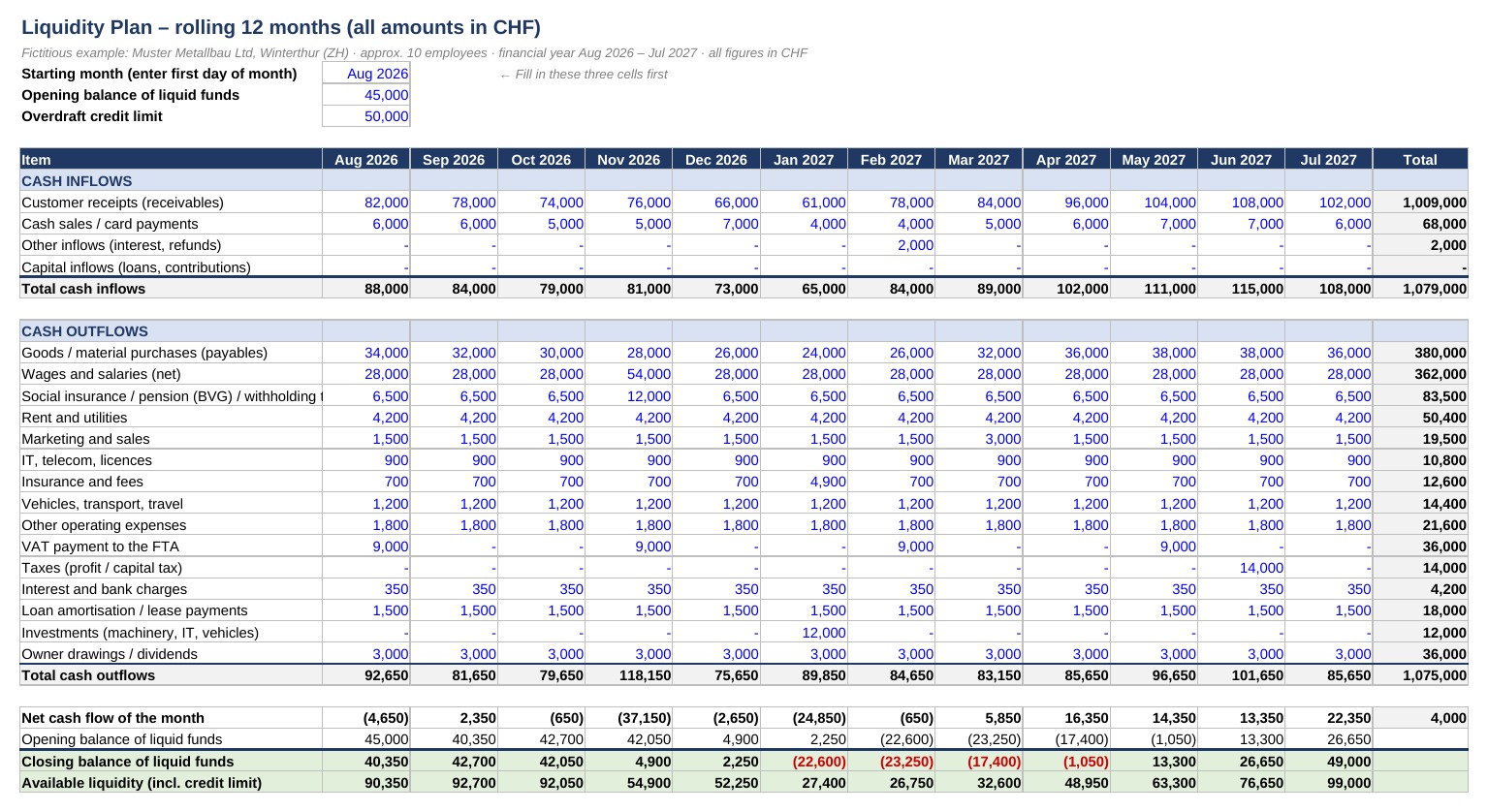
Example of a liquidity plan generated by Claude

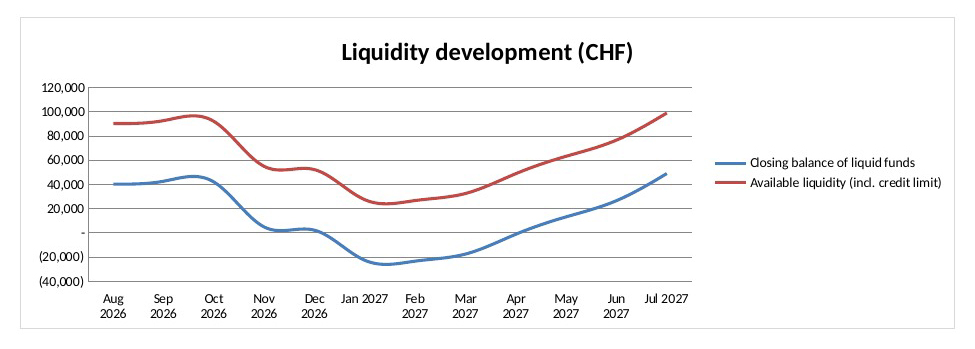
The illustration shows an example of a rolling 12-month liquidity plan generated by Claude. An Excel-style spreadsheet is used to show planned incoming payments, outgoing payments, net cash flow, liquidity at the beginning and end of each month, and available liquidity including credit line for a period of 12 months. Incoming payments include for example sales revenues, other operating receipts, loans and credits, capital and private deposits, as well as other payment receipts. Outgoing payments include for example materials and goods purchases, personnel expenses, social security contributions, rent, energy, insurance, marketing, administration, investments, VAT, taxes, interest, loan repayments and private withdrawals or profit distributions. An additional section summarizes the key figures and early warning indicators: lowest liquidity balance, month with the lowest balance, average net cash flow per month, number of months with negative liquidity and liquidity at the end of the planning period. A line chart visualises the trend in liquidity over the entire planning period.
Note: The figures shown are examples – please replace all values with your own planned figures.
All blue cells are input cells containing fictitious example values – replace them with your own figures. Red figures in the closing balance = current account is being used.

Tip

Rolling liquidity planning only becomes a genuine management tool when the plan is compared with the values actually realized, the largest positive and negative variations are analysed, and measures are taken and implemented where necessary. This is ensured by means of a recurring plan-do-check-act control process. 

A good banking relationship is not a measure for emergencies. It is part of financial risk management. SMEs in particular should not wait until things get tough before contacting their financing partners. Personal banking relationships play a more significant role than at major corporations and should be cultivated when times are good.

“Based on my experience in the volatile energy sector – at Alpiq and Swissgrid – the answer is: scenarios, scenarios, scenarios. CFO Luca Baroni

You cannot control the future, but you can be prepared. Good liquidity management always involves multiple scenarios. Ask yourself questions such as:

  • What happens if a major customer is lost?
  • What happens if customers pay later?
  • What happens if interest rates rise?
  • What happens if exchange rates weigh on margins or if planned results fall short?
  • What happens if a major investment ties up more funds than planned?

At the same time, sound banking relationships and a clear line of credit are crucial in a volatile economic environment – as a buffer that will hopefully never be needed.

Why rapid growth can cause problems with liquidity

Growth is good, but uncontrolled growth can destroy a company. Cash is king – especially during periods of growth. Invoice quickly and consistently, shorten payment terms where possible, and question every investment step in terms of its impact on liquidity. Companies that are growing strongly should plan for double the liquidity requirements originally anticipated – growth always costs more cash than expected. And very important: start by drawing up a qualitative and quantitative business plan that you can use to guide your decisions and manage variations on an ongoing basis. 

The 10 most important rules for stable liquidity at SMEs

  • In the short term, liquidity is more essential for survival than profit – never forget that.

  • Implement rolling liquidity planning.

  • Build up a buffer of at least three months’ expenses.

  • Invoice immediately – not at the end of the month. This requires agreements to that effect with customers.

  • Follow up on outstanding invoices consistently.

  • Cultivate your banking relationship – including when you don’t need money.

  • Digitize your payment and reminder processes first.

  • No investment without a liquidity and financing check.

  • Use monthly figures as a management tool.

  • Growth often costs more cash than is available – so factor in a buffer.

Interview with Luca Baroni: “Numbers don’t lie – but they never tell the whole story either”

Numbers are important. But good financial management takes more: trust, communication, and the courage to give voice to uncomfortable truths. Financial expert Luca Baroni explains why a CFO is above all a translator, how digitalization is changing SME financial management, and what advice he gives to fledgeling companies.

  • My most defining experiences were in the energy sector – at Swissgrid, where as CFO I shared financial responsibility for the national extra-high-voltage grid, and later at Alpiq. What no textbook really teaches: just how much leadership and trust matter in finance. Numbers don’t lie – but they never tell the whole story either. A CFO is above all a translator: between numbers and strategy, between the finance department and the rest of the company. And a crisis reveals whether you’ve laid the right foundations when times are good – in terms of liquidity, banking relationships, the team and financial management processes.

  • The CFO sits at the interface between all areas of the company – that makes the role unique. You see the big picture, you can help shape strategy, and at the same time you bear responsibility for ensuring that the foundations remain stable. What motivates me personally is the combination of complexity and impact: you are partly responsible for the short and long-term survival of the company, and therefore for the jobs of all employees. That’s a big responsibility – and an exciting one for that very reason.

  • Analytical astuteness is a basic requirement, but not enough on its own. A good CFO is also a communicator who can explain complex issues clearly – to the board of directors, the CEO and the company’s staff. Digital literacy is another requirement. And finally, the courage to face uncomfortable truths. The CFO must be the person who can also say no.

  • Digitalization is democratizing financial management: things that used to require large finance teams are now possible for SMEs with smart tools. Real-time bookkeeping, automatic bank reconciliation, digital invoice processing – all of this saves time and reduces errors. At the same time, new requirements are emerging: data security, system integration and the ability to draw the right conclusions from data.

  • AI in finance is already here – for forecasting, risk assessment and automated analysis. Open banking and real-time payments are accelerating the liquidity cycle. At the same time, regulatory requirements are on the increase, for example, with regard to ESG reporting – once major customers start asking for the relevant evidence, SMEs are also affected. And the interest rate turnaround continues to be an issue: financing costs are again a key control variable and part of financial risk management.

  • Take finances seriously from the outset – not just when things get tough. Understand your numbers yourself, even if you employ a specialist. Build a relationship of trust with your bank early on. And get experience on board: having an experienced CFO or financial advisor as a sparring partner can make all the difference at the right moment.

Ensure liquidity: what financing solutions can SMEs use?

You can use these tools and options to manage and control your liquidity easily and intuitively.

Self-assessment: How well is your liquidity management arranged?

Finally, it’s worth taking a look at your own company. The following questions will help you identify risks in financial management at an early stage – before a small shortfall turns into a serious liquidity problem. Assess your SME using these four points as a basis:

Are we confusing profit with liquidity?

A company can be profitable and still find itself in a liquidity crisis. What matters is not only whether invoices have been issued, but whether the money is in your account in good time.

Self-assessment

  • Do we know how much liquidity will actually be available to us in the weeks ahead?
  • Can we pay salaries, suppliers, social security contributions and VAT on time?
  • Do we undertake rolling liquidity planning?

Is our planning too optimistic?

Revenues are often overestimated, costs underestimated and delays not taken into account – which is precisely what creates dangerous shortfalls.

Self-assessment

  • Are our revenue assumptions realistic, or do they tend to be wishful thinking?
  • Have we factored in late payments, higher costs or project delays?
  • Are we also calculating with conservative or negative assumptions?

Do we have scenarios for bad times in place?

Nobody can control the future. But every SME can prepare for potential stress situations.

Self-assessment

  • What happens if an important order falls through?
  • What happens if customers pay late?
  • What happens if costs, interest rates or currency risks rise?
  • Have we defined specific measures in the event that any of these scenarios occur?

Are we too dependent on individual major customers?

A major customer can bring stability – but can also be a risk. Losing the customer or the customer deferring payments can quickly tip the financial situation.

Self-assessment

  • To what extent do our revenues depend on individual customers?
  • What would happen if our biggest customer paid late or was lost?
  • Do we have reserves, alternatives or measures in place to cushion against this kind of dependence?

FAQs

  • In accounting terms, profit is when revenues exceed expenses – liquidity means that the money is actually in your account and available. There are often weeks between these two points in time, which is precisely where the dangerous time lag is. A company can be profitable on paper and at the same time be unable to pay its salaries.

  • Yes – and it happens more often than many people think. The classic scenario: revenues and margins are looking good, but a major customer won’t be paying until 60 days from now, while salaries and social security contributions are due at the end of the month. Profitability doesn’t protect against insolvency – liquidity does.

  • As a rule of thumb, a buffer of at least three months’ expenses is needed to cushion against unexpected events. This is considered a minimum reserve and should be built up during quiet periods, not only when things get tight.

  • The order: payment processes first (incoming and outgoing), then reminders, then liquidity planning, even if it’s just a rolling, multi-week forecast. Issuing invoices quickly and digitally and entering incoming payments automatically gives you an immediate liquidity advantage – because money flows more quickly. Payment processes – both incoming and outgoing.

  • Growth ties up more funds (e.g. cash) than expected, because payments will have to go out before customer payments come in. The recommendation is to be more generous in planning liquidity requirements during periods of growth than originally estimated – double the amount if in doubt – and check the impact of every investment step on liquidity. It is also important to issue invoices quickly and to shorten payment terms where possible. During a period of growth, it is of course crucial not to overlook the financing side, because it is often not possible to fund a major period of growth from available cash alone. This is where equity measures and the debt financing markets come into play. 

This page has an average rating of %r out of 5 stars based on a total of %t ratings
You can rate this page from one to five stars. Five stars is the best rating.
Thank you for your rating
Rate this article

This might interest you too