Stablecoins in asset allocation: the role of liquidity reserves

15.09.2026

Asset allocation determines how capital is distributed across asset classes. One component of this is the liquidity reserve – and this is exactly where stablecoins come in. Within the crypto ecosystem, they provide a digital reserve that is available around the clock, even when banks and stock markets have long since closed for the day. Depending on how they are used, they can generate additional income.

At a glance

In asset allocation, stablecoins take on the role of liquidity reserves within a crypto portfolio and enable round-the-clock reallocation.

  • They facilitate tactical rebalancing without the capital having to leave the crypto ecosystem.
  • This is, however, offset by risks such as currency fluctuations, a lack of depositor protection and issuer and platform risks.

Subscribe to our crypto newsletter to receive the most important news and developments about cryptocurrencies every month

It’s Saturday evening, and a geopolitical development or an important economic news story is suddenly making headlines all around the world. While traditional stock exchanges are closed, crypto markets can respond to new information around the clock. Depending on the event, the prices of cryptocurrencies can rise or fall significantly within a matter of minutes. The problem with this is that, while crypto prices are already reacting to new information, traditional financial markets remain dormant.

One possible advantage of the round-the-clock availability of the crypto market is that investors can react to new developments even outside the trading hours of traditional stock exchanges. With stablecoins, i.e. cryptocurrencies that are usually pegged one-to-one to the value of a state currency such as the US dollar, crypto positions can be reallocated even in the middle of the night. If, for example, you exchange bitcoin for a stablecoin when prices fall, you are no longer exposed to price fluctuations. Instead, the equivalent value is transferred to a stablecoin whose value should remain as stable as possible compared to the respective reference currency. However, it should be noted that stablecoins are also subject to risks and their value stability is not guaranteed.

At a glance: the three roles of stablecoins

As a digital liquidity reserve within asset allocation, stablecoins serve three main purposes within a portfolio:

  • Reserve and protection
    Part of the portfolio is deliberately held in stablecoins, providing a cushion that is available at any time. If prices fall, additional capital can be reallocated to stablecoins within a matter of minutes and parked there without leaving the crypto ecosystem. This can be done at any time, including at night and on weekends.
  • Rebalancing
    If the weighting differs from the strategic target allocation, capital can be redistributed quickly between the crypto assets. This means that the desired allocation is maintained without having to wait for banking days.
  • Possible returns
    A stablecoin reserve can be lent out through decentralized finance (DeFi) platforms, allowing it to earn interest. This takes place outside PostFinance and involves additional risks. Past returns are no guarantee of future results.

The foundation of asset allocation

The various use cases for stablecoins outlined above can be viewed through the lens of a financial investment principle: asset allocation. This is considered to be one of the most important factors influencing the risk-return profile of a portfolio. It describes how assets are distributed across various asset classes, such as shares, bonds, cryptocurrencies and liquidity. More on this can be found in the article “Asset allocation: investing your assets in a structured way”.

In practice, a distinction is made between strategic and tactical asset allocation. Strategic allocation defines the long-term basic distribution, while tactical allocation makes it possible to deviate from this in the short term in order to react flexibly to the market. A liquidity reserve can play an important role in this. It enables capital to be reallocated at short notice if required or to be kept ready for new investments.

Three ways to hold liquidity

In practice, there are often three options for a short-term liquidity reserve: a bank account, a money market fund or a stablecoin.

CriterionBank accountMoney market fundsStablecoin
Criterion
Available outside bank and stock market opening hours
Bank account
No, with the exception of instant payments
Money market funds
No, reallocation takes time and may incur fees
Stablecoin
Yes, continuously within the crypto ecosystem
Criterion
Revenue potential
Bank account
Depending on the account, usually low
Money market funds
Low, determined by short-term interest rate
Stablecoin
Possible with additional use (e. g. DeFi); not guaranteed
Criterion
Protection
Bank account
Depositor protection (up to CHF 100,000)
Money market funds
Segregated assets (protected in the event of bankruptcy)
Stablecoin
Dependent on issuer and reserve quality

The round-the-clock availability of stablecoins only applies within the crypto ecosystem and therefore for crypto positions. Re-exchanging stablecoins into Swiss francs also depends on the banking services offered and is not possible around the clock with all providers. If a bank offers integrated crypto trading around the clock, this step can also be taken at any time.

Who are stablecoins actually of interest to?

Stablecoins are of the greatest benefit to investors who already have cryptocurrencies in their portfolio or who invest regularly within the crypto ecosystem. For investors who invest exclusively in traditional asset classes such as shares, bonds or funds, stablecoins usually play a secondary role in asset allocation at present.

Rebalancing in practice: two scenarios

To illustrate this, let’s consider a portfolio that consists of 60 percent shares, 30 percent bonds, 5 percent bitcoin and 5 percent liquidity reserves in the form of USDC.

Scenario 1: Price decline and restoration of target weighting

If the price of bitcoin collapses sharply, its share in the overall portfolio can fall from 5 to 3 percent, for example. If the originally determined portfolio weighting is to be restored, part of the liquidity reserve can be reallocated to bitcoin. How quickly this is possible depends on the structure of the portfolio:

  • If you already hold the liquidity reserve as a stablecoin, you can immediately exchange it for bitcoin, regardless of the day of the week or time.

  • If the liquidity reserve is in a bank account, an immediate purchase is possible, provided your bank offers integrated crypto trading around the clock.

  • If the bank account and crypto portfolio are separate, a transfer is required first. The amount of time that this takes depends on the payment services offered and the respective banking processes.

The example is intended solely to illustrate a possible rebalancing. Whether reallocation will prove beneficial after the event depends on future market developments and cannot be predicted.

Scenario 2: Price increase and reduction of an overweight position

If the price of bitcoin rises sharply, its share in the overall portfolio can grow from 5 to 10 percent, for example. This differs significantly from the originally intended weighting. Rebalancing will reduce this overweight position by transferring part of the bitcoin position back into the liquidity reserve. The speed at which this can happen depends on the same three paths as in scenario 1, but in the opposite direction: a direct exchange for a stablecoin is possible at any time, a payment to a bank account depends on whether your bank has a round-the-clock service, and, in the case of separate accounts, the transfer follows the respective banking processes. 

Opportunity cost risk: the cost of waiting

In both scenarios, there is a potential loss of time – especially if a transfer is required between a bank account and a separate crypto portfolio. If both sides support instant payment, the reallocation usually takes place immediately; depending on the bank, additional fees apply. If there is no instant payment option, the reallocation may be delayed while the market develops. This is what is known as opportunity cost: the risk of missing out on a potentially cheaper trading opportunity while waiting.

Return: potential income on stablecoin reserves

The round-the-clock availability of stablecoins is just one side of the coin. Stablecoins can also generate income depending on how they are used.

Generating income

While traditional savings deposits in a bank account generate hardly any interest, a stablecoin such as USDC may have a different outlook. While simply holding a stablecoin such as USDC does not generally result in any returns, these can arise if stablecoins are made available to other market participants via a so-called DeFi (decentralized finance) credit platform. In return for the liquidity provided, investors receive variable income. The amount of this income depends on the supply and demand on the relevant platform and is not guaranteed.

The use of DeFi credit platforms does, however, entail additional risks. This includes technical risks, such as errors in smart contracts, as well as risks associated with the relevant platform or the collateral deposited. Furthermore, there is no depositor protection as there is with a bank. Given these particular characteristics, DeFi credit platforms are primarily aimed at experienced crypto investors. An in-depth introduction to decentralized financial applications is also provided in our article “Understanding DeFi: the opportunities, risks and applications of decentralized finance”.

Comparing the figures

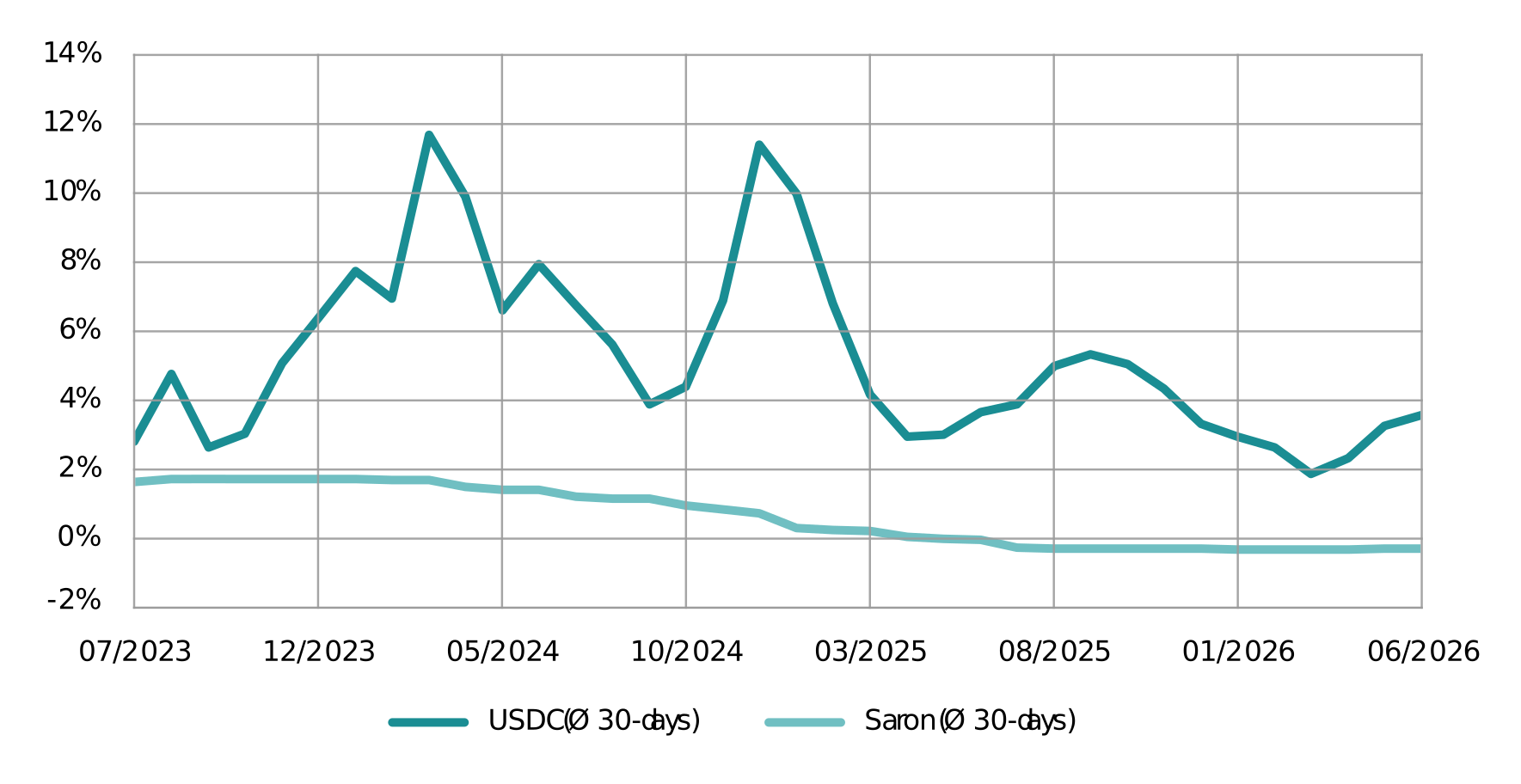
Over the past three years, between June 2023 and June 2026, the interest rate on the eleven largest and highest-volume USDC credit pools has historically averaged 5.82 percent per year, with temporary swings of more than 10 percent during periods of high credit demand. The Swiss money market (SARON), on the other hand, fell over the same period to an overall average of 0.77 percent per year, a direct result of the interest rate cuts by the Swiss National Bank (SNB).

Liquidity reserve comparison: Returns on USDC vs. Saron

Source: own calculation based on daily aggregated log data of the eleven highest-volume and most liquid USDC credit pools; 30-day average; data: Defilma, SNB; 1 June 2023 to 1 July 2026

These historic figures are a snapshot, not a promise for the future. Interest rates on DeFi platforms fluctuate and can fall at any time, for example if the US Federal Reserve (Fed) cuts policy rates or there is less demand for credit on the platforms.

What are the risks associated with stablecoins?

Anyone using stablecoins and DeFi platforms should be aware of the following risks

  • : Foreign currency risk: as USDC is pegged to the US dollar, Swiss investors bear a foreign currency risk. If the Swiss franc appreciates against the US dollar, the equivalent value in Swiss francs of the position held in USDC will fall.
  • Default and issuer risk: USDC is issued by the private company Circle, the issuer. According to the issuer, the coin should be fully covered by reserves, especially cash and short-term US government bonds. However, there is no state depositor protection, as is the case with a traditional bank account.
  • Risk of loss with self-custody: if you hold stablecoins in your own wallet instead of with a regulated bank, you bear full responsibility for custody. If the private key is lost or falls into the wrong hands, the coins are irretrievably lost.
  • Fluctuating returns: the interest rate on DeFi platforms is not guaranteed. It is dynamic and can fall quickly, for example if demand for credit in the crypto market falls.
  • Technical platform risk: DeFi platforms run via automated computer programs (smart contracts). Errors or security gaps in the program code can lead to losses, such as hacker attacks, which are usually irreversible in the decentralized system.
  • Regulatory uncertainty: the legal framework for stablecoins and DeFi income is constantly evolving both worldwide and in Switzerland.

A digital franc to counter foreign currency risk

The global stablecoin market today is almost exclusively geared towards the US dollar. There is still no widely usable, regulated Swiss franc stablecoin. This could change: PostFinance is testing the use cases for a digital Swiss franc in collaboration with six other Swiss financial institutions – including UBS, Raiffeisen and Zürcher Kantonalbank. The joint project will run in a protected test environment (known as a sandbox) until the end of 2026. This test phase is no guarantee of subsequent market launch. Yet, if such a Swiss franc stablecoin were to emerge, it would significantly reduce the foreign currency risk for Swiss investors and create a liquidity reserve in the domestic currency that is ready to use around the clock.

To sum up: what does this mean for investors?

Stablecoins can be a useful addition to liquidity management within a crypto portfolio and make it more flexible. In the context of asset allocation, stablecoins are used primarily as a liquidity reserve and not as an investment for achieving price gains. The combination of their value stability and the round-the-clock availability of the crypto market means that they offer a high degree of flexibility with regard to reallocation and can also enable additional returns, depending on how they are used.

For purely traditional portfolios without a crypto connection, stablecoins usually play a minor role in asset allocation at present. There are also risks associated with their use – including exchange rate risk against the US dollar, issuer risk and technical and regulatory risks. Anyone who takes these framework conditions into account can use stablecoins as a potential component in their portfolio, closing the gap between rigid bank terms and the dynamism of digital markets.

Frequently asked questions about stablecoins

  • Money in a bank account is protected by statutory depositor protection (up to CHF 100,000). Stablecoins do not offer this protection. While cryptocurrencies held with regulated Swiss providers are generally segregated in the event of bankruptcy, this does not protect against a potential loss in the stablecoin’s value. In addition, many bank and securities transactions are only processed during bank and stock exchange opening hours, while stablecoins can be transferred and traded around the clock.

  • Stablecoins are generally considered less volatile than many other cryptocurrencies, but are not risk-free. The most important risks include issuer risk, possible decoupling from the benchmark, technical risks and custody risks.

  • A stablecoin itself is geared towards value stability and not towards achieving price gains. Depending on use, stablecoins can generate additional income via DeFi platforms. However, this is not guaranteed and does entail additional risks.

  • That depends on your own investment goals. For investors who are not active in the crypto market, the bank account generally performs the function of a liquidity reserve. Stablecoins are particularly relevant for people who are already investing within the crypto market.

  • Stablecoins can serve as a liquidity reserve within a portfolio. They allow capital to be reallocated without having to go through the traditional banking system, and can therefore facilitate rebalancing or switching between different crypto investments. Whether this makes sense in individual cases depends on the individual investment strategy and the relevant market conditions.

  • Both are blockchain-based forms of digital money, but they differ in terms of issuer. Stablecoins are issued by private companies, whereas central bank digital currency (CBDC) is issued by a central bank. CBDCs would therefore be government-hedged, while the stability of a stablecoin depends on its private issuer and its reserves. Central bank digital currency is not yet available to private individuals in Switzerland.

  • The first Swiss franc stablecoins already exist, but none has yet become widely established or is available through the Swiss banking system. PostFinance is currently working with a host of other Swiss financial institutions to test potential use cases in a protected test environment known as a sandbox. No decision about introducing it has been made.

This page has an average rating of %r out of 5 stars based on a total of %t ratings
You can rate this page from one to five stars. Five stars is the best rating.
Change rating
Thank you for your rating

This might interest you too