What payment methods should a Swiss online shop offer?

15.06.2026

Customers often cancel a purchase when they get to the payment step – not because of the product, but because the desired payment method is missing or checkout is too complicated. In Switzerland in particular, customers now expect standards such as TWINT, debit and credit cards and PostFinance Pay. Anyone failing to offer these options risks cancelled purchases and loss of revenue. The key factor is not the number of payment methods, but the choice of the right payment methods for the target group, shopping basket and business model.

At a glance

  • For Swiss online shops, TWINT, debit and credit cards and PostFinance Pay are important minimum setup requirements.
  • Payment by invoice can increase conversion.
  • Not every payment method is worthwhile for every business model. The decisive factors are target group, shopping basket size, international orientation and risk.
  • A clear, well-chosen selection is usually better than having as many options as possible.
  • By regularly checking how customers want to pay, you can reduce cancelled purchases and manage fees better.

What payment methods do customers expect in Swiss online shops?

If you sell online, you don’t have to offer every payment method available. The key thing is to provide the payment methods that customers actually expect and regularly use. A look at the Swiss Payment Monitor published by the University of St.Gallen and the Zurich University of Applied Sciences (ZHAW) shows that Swiss online retail is now dominated by a few key payment methods. Over 90 percent of all online purchases in Switzerland are paid for using the following payment methods:

  • TWINT
  • credit cards
  • payment by invoice or transfer
  • debit cards

For many Swiss SMEs, these payment methods represent the most important minimum standard in online shops.

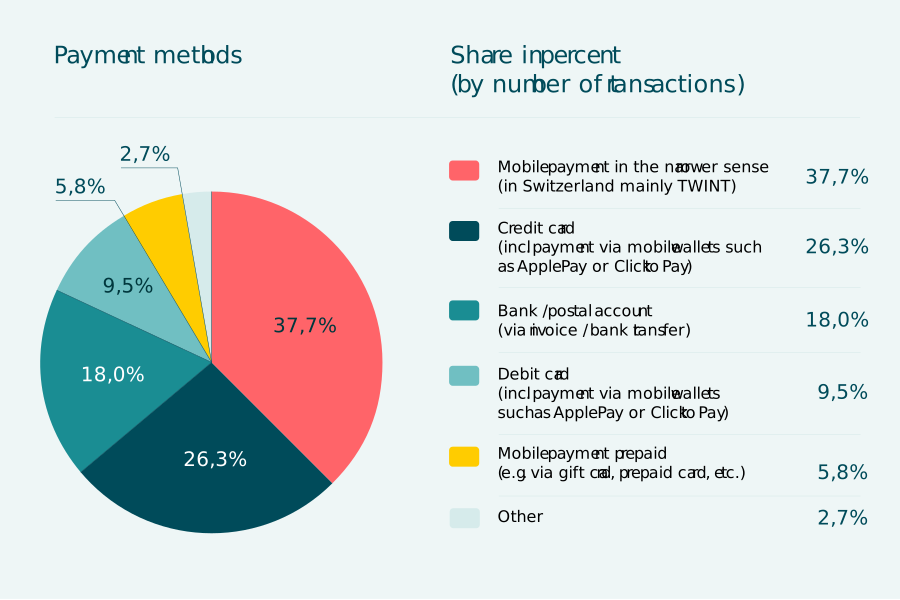
Preferred payment methods in Swiss online shops

The pie chart shows the distribution of payment methods used in Swiss online shops by number of transactions as a percentage, with mobile payment – mainly via TWINT – accounting for the largest share at 37.7 percent, followed by credit cards including payment via mobile wallets such as Apple Pay or Click to Pay (26.3 percent), bank and PostFinance account payments via invoice or transfer (18.0 percent), debit cards including payment via mobile wallets such as Apple Pay or Click to Pay (9.5 percent), mobile prepaid payments (5.8 percent) and other payment methods (2.7 percent).

What payment methods does a Swiss online shop need at minimum?

The following table shows a minimum setup that may be appropriate for typical Swiss online shops. Important: every business model is different – the target group, the average order value and the risk determine what payment methods are really necessary.

The minimum setup for many Swiss SMEs

Business modelRecommended payment methodsNotes
Business model
Small Swiss online shop
Recommended payment methods
TWINT, debit and credit cards Mastercard/Visa, PostFinance Pay
Notes
The combination covers the majority of Swiss customers. PostFinance Pay targets around 2.4 million PostFinance customers.
Business model
Larger shopping baskets / products that require explanation
Recommended payment methods
+ payment by invoice
Notes
Payment by invoice increases trust and conversion, but entails default risks. These can be outsourced to external providers (e.g. POWERPAY).
Business model
International customers
Recommended payment methods
+ PayPal, other credit cards (e.g. American Express) or Alipay, WeChat Pay or JCB
Notes
International buyers often expect PayPal or several credit cards.
Business model
Subscription models / recurring payments
Recommended payment methods
PostFinance Pay, debit and credit cards or TWINT with token
Notes
These payment methods enable recurring payments, one-touch payments or invisible payments. After a one-off registration in the personal profile with the retailer, no further authentication is required.
Manage payment methods easily and centrally.

The most important payment methods at a glance

TWINT is now practically standard for Swiss online shops – especially for mobile purchases.

Credit cards enable retailers to access an international customer base and ensure fast, secure transactions worldwide. They are a key standard in online retail.

Debit cards expand the target group that can be reached, as customers without a credit card can also pay directly. For retailers, this means additional potential purchasers and stable, instant incoming payments directly from a bank account.

PostFinance Pay gives retailers access to a large, well-established user base in Switzerland. Direct payment via the PostFinance App ensures a simple checkout process. PostFinance Pay replaces the previous PostFinance payment methods “PostFinance Card” and “PostFinance e-finance”.

Useful information

With Checkout from PostFinance, you have the option of offering all common payment methods, including PostFinance Pay, via a single contract.

Payment by invoice increases customers’ willingness to buy and their trust. Retailers can outsource the risk of default and the administrative effort to specialized providers (e.g. POWERPAY from MF Group, offered via “Checkout Flex” from PostFinance), to enjoy the benefits without additional effort.

In the case of advance payment, customers transfer the amount to the retailer’s account before receiving the goods. This payment method is ideal for online shops that do not wish to assume any risk of payment defaults. It is particularly suitable for standardized products and price-sensitive customers, but is less suitable for spontaneous purchases, as it slows down the purchasing process and requires greater trust from customers.

Many customers now pay directly using their smartphone or in a browser. This is why wallets such as Apple Pay, Google Pay and Click to Pay are gaining in importance in online retail.

Important information

These solutions are usually not payment methods in their own right, but are based on stored debit or credit cards. For retailers, this means that accepting cards often automatically enables modern payment via a smartphone or browser.

On mobile devices in particular, wallets can help simplify the checkout process and reduce cancelled purchases. A few clicks often determine whether a purchase is made or not.

What payment methods increase conversion rates?

Payment methods have a direct impact on whether customers complete a purchase or cancel it. Fast, familiar and mobile-friendly payment methods are particularly important. In Swiss online shops, the following payment methods in particular are considered especially favourable for high conversion rates:

  • TWINT
  • PostFinance Pay
  • credit cards
  • Apple Pay or Google Pay
  • payment by invoice

Also important

Not every payment method increases conversion rates to the same extent for every target group. The decisive factors include the sector, shopping basket size and customer expectations.

Overview: what payment methods are best suited to my online shop?

In our overview, you will find a list of many common payment methods for online shops. This can help you to select the ones you need for your online business.

How to choose the right payment methods

No matter whether you have an online shop, a restaurant or a retail outlet: as a retailer, you can expand your customer base and generate more sales with the right payment methods. These four questions can help you choose the right payment methods:

  • Payment habits determine conversion rates.

  • Higher amounts benefit from payment by invoice or credit card.

  • Higher fees can be worthwhile if they result in greater conversion rates.

  • The risk may be outsourced to external providers.

What do I need in order to be able to offer the payment methods?

In order to be able to offer different payment methods, you need a payment service provider (PSP) to take care of technical payment processing and enable the integration of payment methods such as TWINT, credit cards or PostFinance Pay into your online shop.

For many SMEs, an all-in solution makes sense. It allows payment methods, technical integration and payment processing to be managed centrally – with just one contact person.

There are often important differences in:

  • the payment methods supported,
  • the fee models,
  • the integration into shop systems,
  • and support and reporting.

PostFinance Checkout supports common payment methods and can be integrated into many shop systems. Depending on the business model, various pricing and flexibility models are available – from simple, entry-level solutions to individually configurable solutions for larger shops.

What fee structure suits my shop?

Transaction fees are incurred for online payments. How high they are depends on the payment service provider, the payment methods offered and the sales volume of your online shop. The key factor is not just how high the fees are, but also the model that best suits your business model.

Shop typeFrequently appropriate fee structureWhy
Shop type
Small online shop
Frequently appropriate fee structure
Uniform fees
Why
Easy to understand and calculate
Shop type
Growing shop
Frequently appropriate fee structure
Different fees according to payment method
Why
Cost optimization depending on the payment mix
Shop type
High sales volumes
Frequently appropriate fee structure
Individually negotiable conditions
Why
Greater flexibility and lower fees possible

Fee structures in detail

  • With this model, retailers pay a fixed percentage per transaction – regardless of what payment method is used. This is particularly suitable:

    • for smaller shops,
    • when starting out in e-commerce
    • or if simple and transparent costs are important.
  • Here, the fees vary depending on the payment method. For example:

    • debit cards, TWINT and PostFinance Pay may be cheaper,
    • while credit cards or payment by invoice may incur higher fees.

    This model is often worthwhile for shops with regular revenue and a clear payment mix.

  • Larger online shops can often negotiate fees individually with acceptance partners or payment service providers. This is particularly interesting in the case of:

    • high transaction volumes,
    • international customers
    • or more complex payment set-ups.

Important information

The cheapest payment method is not automatically the most cost-effective. Payment methods with higher fees may at the same time improve conversion rates and reduce cancelled purchases.

Offer precisely the payment methods that suit your company

Do you need to make a decision regarding the payment methods you wish to offer in your online shop? PostFinance offers attractive price plans. Arrange a personal consultation with us.

FAQs

  • The greatest risk for sellers is payment default – in other words, customers not paying for a product or service that has been delivered. The most secure payment methods are as follows:

    • Advance payment: Goods are not sent until the payment is received
    • Credit and debit cards
    • Debits from the account, as with PostFinance Pay
  • This depends on the price plan selected.

    Go to PostFinance Checkout price plans

  • TWINT, debit cards, PostFinance Pay and credit cards from Mastercard and Visa are among the most relevant payment methods in Swiss online shops.

  • As revenue or international customers increase, additional payment methods such as PayPal, payment by invoice or other credit cards may become useful.

This page has an average rating of %r out of 5 stars based on a total of %t ratings
You can rate this page from one to five stars. Five stars is the best rating.
Thank you for your rating
Rate this article

This might interest you too