Starting an online shop: which shop system is best suited to your business model?

22.06.2026

You want to sell online and are faced with technical decisions? Shop systems, plug-ins, payment providers: the choice quickly appears complex. In this post, you will find out what shop systems are suitable for what situation, what role checkout, payment methods and their integration play and how to get off to the right start from the outset without having to make costly corrections later.

At a glance

  • The right way to get started in online retail depends on your business model, budget and technical know-how.
  • Many company founders start out with rental shops such as Shopify or Wix because they can be set up quickly.
  • Important: consider checkout and payment methods early, including the technical integration of the payment system, to avoid cancelled purchases.

Quick check in four steps

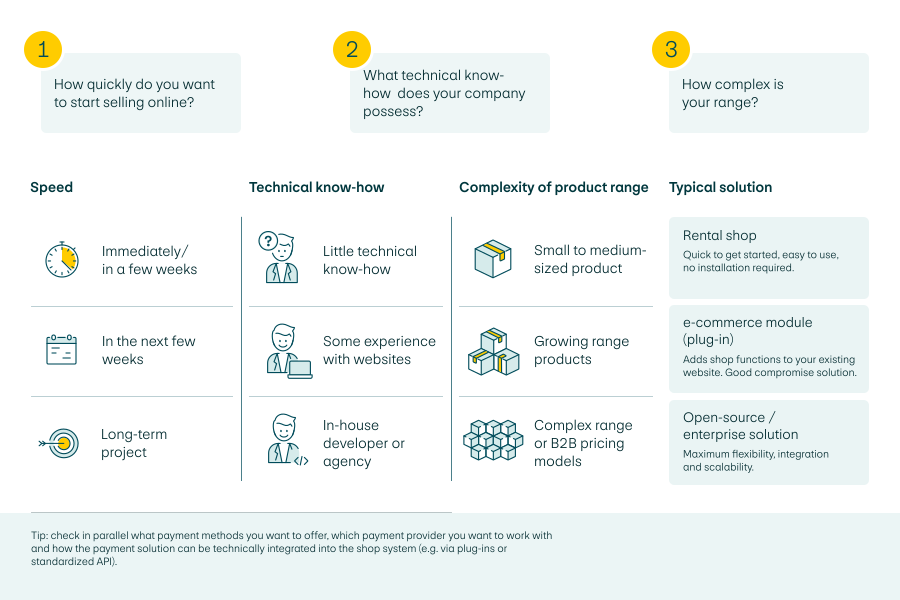
Our quick check provides easy guidance for SMEs looking for a suitable shop system. It shows which solution is generally the best fit on the basis of three key criteria – speed, technical know-how and the complexity of the product range. This allows you to make a rough assessment of whether a rental shop, an e-commerce module or an open-source or enterprise solution makes sense. The fourth step is to set up the payment process in parallel. 

Three typical starting points in online retail and which shop solutions are suitable for them

Some want to start selling online as quickly as possible, while others have to establish an independent digital presence from the outset, as they need to take complex (sales) processes into account. The important thing is your current situation and how you intend to develop.

Starting point

As an SME, you want to start selling quickly online, have few in-house technical resources and little or no IT know-how of your own. 

Practical example

Anna sets up a small jewellery label and wants to sell her products online. Since she wants to get started quickly and has little technical know-how, she opts for a rental shop. Within a few days, she creates her shop, uploads products and integrates payment methods such as TWINT, credit card or PostFinance Pay.

Why this shop system is ideal

Rental shops enable particularly fast and low-risk entry into online retail. SMEs benefit from ready-made designs, intuitive operation and simple product management. You can use numerous functions without much effort – for example, to integrate payment systems or customer accounts. It works like an online shop toolkit. Software configuration, maintenance and updates are carried out entirely by the provider.

What you need to know

The customization options are limited and ongoing fees apply. There is also a certain dependence on the provider, particularly in terms of the range of functions and further development.

Starting point

Your company already has an existing website and would like to expand it to include an online shop without building everything from scratch. At the same time, there is a desire for greater flexibility than with a rental shop.

Practical example

Marco runs a website for his coffee roasting company, which so far has only been updated with information on products and opening hours. As demand for online orders is increasing, he is expanding his existing site to include an online shop. Instead of starting all over again, he integrates a flexible shop system into his website, adding functions such as shipping and payment methods. This allows him to start selling online quickly without having to build everything from scratch.

Why this shop system is ideal

This web shop software combines content, marketing and sales on a single platform. Products, blog articles, landing pages and SEO can be managed centrally. These systems also offer considerably greater freedom of design and functionality than traditional rental shops. Thanks to large ecosystems with themes and interfaces, shops can be expanded in a targeted manner and adapted to individual marketing and sales processes.  payment plug-ins, and many more. These can be a good solution.

What you need to know

Hosting, maintenance, updates and security are the responsibility of the SME itself or a service provider. The technical workload is higher, which is why this solution requires a little more experience or external support.

Starting point

Your business model is complex. You offer a wide range of products, have individual prices and predominantly B2B customers, you serve several sales channels or the shop system requires deep integration into existing ERP or CRM systems.

Practical example

A Swiss startup operates a B2B platform for sustainable packaging with a wide range of products and complex ordering processes. Many customers place orders with individual terms and conditions, in some cases via framework agreements. The company also sells via several channels – online shops, distribution and marketplaces – and must closely link orders, warehouses and customer data with ERP and CRM systems. The startup also wants to grow quickly and relies on an open-source or enterprise system with high adaptability and integration capability.

Why this shop system is ideal

These shop systems are designed to map the online shop as a key value creation component. They can be completely customized and enable complex logics, special price structures and deep system integration.

These systems are particularly useful in the long term for growing SMEs or companies with a clear digital strategy.

What you need to know

Operation requires professional partners, clear requirements and a corresponding budget. Set-up and development are more cost-intensive, but highly scalable. 

Typical mistakes when starting an online shop

When starting out in online retail, similar challenges often arise. Typical mistakes include:

  • choosing a shop system that does not fit the business model
  • defining payment methods late
  • not getting payment providers on board at an early stage 
  • underestimating technical requirements
  • not planning marketing and customer acquisition until after the launch

Taking these points into account early on avoids the need for subsequent adjustments.


The right shop system is not enough: consider the payment system from the outset

Choosing the shop system is an important decision. To ensure that customers can actually shop later, another key component is required: payment processing. It is particularly at the checkout that the decision is made whether to complete a purchase or cancel it. Although customers have already chosen a product, orders often fail due to a cumbersome payment process or a lack of payment methods.

In Switzerland in particular, TWINT, credit cards, PostFinance Pay, mobile payment and invoicing are standard for customers. Companies that do not meet these expectations risk a loss of revenue.

That’s why it’s already worth thinking about the payment system when planning your online shop and getting the right payment provider on board at an early stage. This means that the required payment methods and the technical integration into the shop system can be coordinated neatly from the outset. Modern payment solutions bundle different payment methods into a single solution. By planning the shop system, payment methods and payment providers together, it is possible to create the basis for an efficient checkout process, better conversion and less administrative effort.

Useful to know: PostFinance Checkout payment solutions, which are compatible with many common shop systems, contain all relevant payment methods and can be integrated easily via API or plug-ins. This provides online shop operators with a one-stop shop. 

A shop system is only as good as its payment processing. That’s why you need to clarify these two questions carefully and at an early stage: can the payment methods that are relevant to me be offered in the shop system? Are additional fees charged for specific payment methods (e.g. for third-party integration)? This will avoid additional costs or technical outlay at a later date.
Fabian Gut, Customer Journey Owner E-Commerce at PostFinance

Good payment system advice for your online shop

We would be happy to discuss your questions about our Checkout solutions for online shops with you in person. 

How do you decide on a shop system? These questions will help you to make a decision

There are many factors that you should weigh up when choosing a suitable shop system. The decision depends on factors such as how good you are at programming, what products you offer, what target group you want to reach and, last but not least, how much money you can and want to spend. 

Business model

  • How extensive and complex is our range?
  • Do we sell B2C, B2B or both?

Resources

  • Do we have internal or external technical know-how (agency, freelancer)?
  • Who looks after the online shop on a day-to-day basis?

Time and budget

  • How quickly do we need to be able to sell online?
  • What is our budget for one-off/ongoing costs?

Features, growth and integration

  • What features do I need (e.g. product search, filters, evaluation, checkout, etc.)
  • Can the shop system grow as the business expands?
  • Is it possible to integrate my third-party systems (e.g. ERP system, cash register or accounting)? 

Checkout and payment methods

  • What payment methods do our customers expect and is it possible to integrate them?
  • Does the shop system support the desired payment solutions?

Independence/dependencies

  • How important is independence from the provider?
  • How individual must the shop, processes and customer experience be?
  • Do I want an all-in-one solution or is it important to me to be able customize the various functions as individually as possible? 
  • How important is it to me that I can continue to develop the shop solution independently of the provider?
  • To how great an extent should the shop differ from its competitors?

So what shop system is the right one?

There’s no such thing as the perfect shop system. The important thing is for the solution to be in line with your business model, resources and growth plans. Many SMEs start out with a rental shop and expand their infrastructure later step by step. If you already have more complex requirements or would like to integrate different systems, you should take these requirements into account from the outset. It is particularly important to plan the shop system, payment methods and payment solution together. This will lay the foundation for a successful start in online retail.

FAQs

  • The majority start with a rental shop because it’s quick, inexpensive and technically simple.

  • Allow for:

    • 20 to 80 CHF/month for rental shops
    • 300 to 3,000 CHF for a CMS expansion
    • 5,000 to 50,000+ CHF for complex shop systems

    Plus: PSP costs and payment fees.

    These figures are rough estimates and serve as a non-binding guide only. The actual figures may differ from the results due to different framework conditions and assumptions.

    • Rental shop: 1–3 days
    • CMS shop: 1–3 weeks
    • Enterprise shop: 1 to several months

    These figures are rough estimates and serve as a non-binding guide only. The actual figures may differ from the results due to different framework conditions and assumptions.

  • Changes of system are possible – but expensive. That is why the starting point is more important than perfection. It is important, at the same time as selecting the shop system, to define the payment methods to be offered in the online shop, to select the payment provider and to ensure the technical integration of the payment solution (and therefore also the payment methods) via plug-in or API.  

  • At a minimum: TWINT, debit cards, credit cards, invoice / mobile payment. 
    Payment methods are the greatest factor resulting in cancelled purchases.

    • Rental shops: the provider
    • CMS shops: you or your agency
    • Enterprise: professional technical support
  • No – customer acquisition must be consciously developed (social media, SEO, ads, newsletter).

This page has an average rating of %r out of 5 stars based on a total of %t ratings
You can rate this page from one to five stars. Five stars is the best rating.
Thank you for your rating
Rate this article

This might interest you too